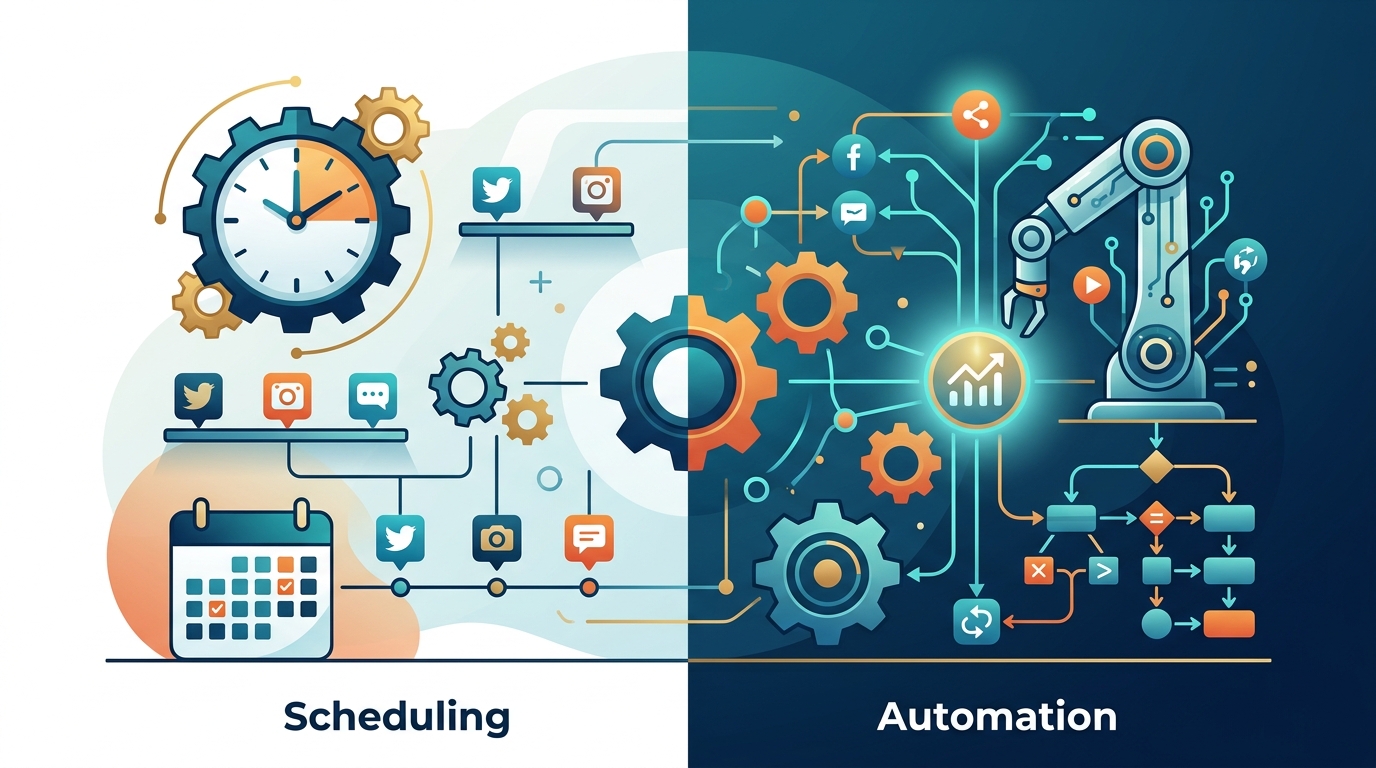
If you've ever lined up a week's worth of posts on a Sunday night, you've used a scheduling tool. But if you think that's the same as social media scheduling vs automation, you're leaving serious time and growth on the table. These two approaches are fundamentally different, and choosing the wrong one for your business can quietly drain your energy without moving the needle.
What Scheduling Actually Does (And Doesn't Do)
Scheduling tools let you write posts in advance and publish them at a set time. That's it. You still do all the thinking, writing, and decision-making. The tool just hits "post" so you don't have to be at your desk at 9 a.m. on a Tuesday.
This works well when:
You have a consistent content calendar already built out
Your posting volume is manageable (think 3-5 posts per week)
You enjoy the creative process and just want help with timing
The limitation? Scheduling is entirely dependent on you doing the upstream work. If your content pipeline dries up, so does your presence. It's a convenience tool, not a growth engine.
What True Automation Actually Looks Like
Automation goes several layers deeper. Instead of just publishing what you've written, it handles parts of the workflow itself. That can mean generating content ideas, adapting posts across platforms, recycling evergreen content, or triggering actions based on engagement patterns.
Think of scheduling as a timer on your coffee maker. Automation is more like a smart home system that adjusts based on your habits, preferences, and what's happening around it.
A real automation workflow might look like this:
You set your brand voice, topics, and posting frequency once
The system generates and queues content based on those parameters
Posts go out across platforms, adapted for each one's format
Evergreen content recirculates automatically on a defined schedule
You review performance and adjust strategy, not individual posts
This is where platforms like Moosen operate. Its Autopilot Intelligence doesn't just schedule what you've already created. It actively reduces the manual work between having a strategy and executing it consistently.
Social Media Scheduling vs Automation: Choosing the Right Fit
There's no universal right answer here. The better question is: where does your time actually go, and where does your process break down?
Scheduling is probably enough if:
You have a dedicated content creator on your team
Your brand voice requires heavy hands-on control
You're posting on one or two platforms with low volume
Content creation is something you genuinely enjoy and protect time for
Automation makes more sense if:
You're a solo operator or small team wearing multiple hats
Your posting is inconsistent because life gets in the way
You need to maintain presence across three or more platforms
You want to scale output without scaling your workload proportionally
Many small business owners start with scheduling and hit a wall around the six-month mark. The content calendar becomes a source of stress instead of a system. That's usually the signal that automation is worth exploring.
The Hidden Cost of Staying in Scheduling Mode Too Long
Scheduling tools create an illusion of efficiency. You batch your content, feel productive, and then spend the next week scrambling to refill the queue. It's a treadmill that keeps moving whether or not you have the bandwidth to keep up.
The real cost isn't the tool. It's the mental overhead of managing a content operation manually at scale. Every post you write from scratch, every caption you tweak for Instagram vs. LinkedIn, every time you forget to post for two weeks because a client emergency came up. That's compounding lost opportunity.
Automation doesn't eliminate your creative judgment. It eliminates the repetitive execution work so your judgment can focus where it actually matters: strategy, relationships, and offers.
How to Make the Transition Without Losing Your Brand Voice
The biggest concern small business owners have about automation is sounding generic or robotic. That's a fair concern, but it's also solvable.
Here's how to move from scheduling to automation without losing what makes your brand distinct:
Document your voice first. Write down 5-10 examples of posts that sound exactly like you. Include tone notes, phrases you use, and topics you avoid.
Start with evergreen content. Automate your highest-performing, timeless posts before experimenting with fresh content generation.
Keep a human review step. Even a 5-minute weekly review of queued content keeps quality high without turning automation into a full-time job.
Use platform-specific settings. Good automation tools let you customize how content appears on each channel. Don't let one post go out identically on every platform.
Measure what changes. Track engagement before and after switching. Automation should improve consistency, which typically improves reach over time.
Tools like Moosen are built with this transition in mind. The goal isn't to replace your voice. It's to make sure your voice shows up consistently, even during your busiest weeks.
The brands that grow steadily on social media aren't the ones who post perfectly. They're the ones who show up reliably. Scheduling can help you plan for that. Automation helps you actually do it, without burning out in the process. Knowing which one you need right now is the first strategic decision worth getting right.